


AGM Notes Increase in Registrant Base
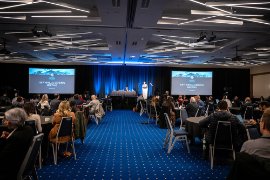
The 2024/2025 Board Chair, Mark Porter, P.Eng., Struct.Eng., hosted Engineers and Geoscientists BC’s 106th Annual General Meeting (AGM) on October 28. A total of 735 people attended in person and online.
Following the territorial greeting by Larry Shucks Nahanee, President of the Squamish Ocean Canoe Family, and Sempulyan Stewart Gonzales, also a member of the Squamish Ocean Canoe Family, CEO Heidi Yang, P.Eng., shared an organizational update.
Yang noted Engineers and Geoscientists BC’s achievements over the past year, which included:
- supporting the BC Society of Engineers and Geoscientists (BCSEG) as they begin independent operations;
- developing Regulatory Principles to clarify Engineers and Geoscientists BC’s approaches to decision making;
- working to reduce barriers for internationally trained professionals, and acknowledging that more work is needed to reduce wait times for professional registration;
- initiating 119 new investigations and resolving 23 cases with disciplinary outcomes;
- completing approximately 500 individual and firm practice reviews;
- hearing feedback from about 4,000 registrants in the organization’s annual Registrant Insights Survey; and
- expanding equity, diversity, and inclusion as well as its Truth and Reconciliation programs, and launching the Organizational Climate Change Strategy.
Financial Update
Yang also shared highlights from the 2024/2025 fiscal year’s budget. Revenue increased to $34.3 million from $32.2 million in the previous fiscal year.
“These numbers reflect growth in our registrant base, which grew by 2,283 professionals and 268 firms this year, representing a 5.3% increase,” Yang said. “This naturally led to increased revenue through individual and firm fees, which made up 65% of our total revenue.”
The current budget does not raise registration fees, and the organization will be running a planned deficit budget of approximately $900,000. The deficit will be covered by tapping into the previous year’s surplus of $2.1 million.
“This deficit budget aligns with our budget guidelines and will help us fund needed project work without making changes to operations or increasing registrant fees,” Yang said.
Question Period
Porter and organization executives fielded questions from registrants during the open question period.
Registrants asked about the delay in application processing timelines and what steps the organization is taking to address those delays. Acting Chief Regulatory Officer Jason Ong acknowledged the impact of longer processing timelines on individuals and firms and noted that the organization is managing an unprecedented volume in applications, with 7,300 received last year. Ong spoke to several measures being taken to address this issue – including adding more assessors and increasing updates to applicants – while still maintaining the integrity of the admissions process.
Questions were also raised about whether the loss of benefits and services that are being transferred over to BCSEG would lead to a decrease in registrant fees. Jennifer Cho, Chief Financial and Administration Officer, noted that while certain costs of running programs will be transferred to BCSEG, so will revenue streams. “There are savings on programs, but there are revenue losses that even things out,” meaning there will be no significant differences to the organization’s bottom line.
Registrants also asked about the areas of practice that may fall under the Applied Science Technologists and Technicians of British Columbia (ASTTBC) purview and whether that would encroach on engineering reserved practice.
Yang shared that Engineers and Geoscientists BC is supportive of reserved practice for applied science professionals and is working closely with the Office of the Superintendent of Professional Governance (OSPG) and ASTTBC to gain clarity on the impact this would have on engineering practice, and that discussions were ongoing. Yang also clarified that the reserved practice of engineering will not be impacted by ASTTBC’s reserved practice but rather would impact the current work engineers do more broadly that does not fall into reserved engineering practice.
Photo: Wendy D Photography